
Food plant flooring: why steam tears epoxy off and what is used instead
A typical story. An epoxy self-levelling floor is laid in a production hall — level, good-looking, under warranty. A season later it is coming off in sheets next to the washing station and around the floor drains. An investigation begins: bad material? poor installation? procedure not followed?
Most often it is none of the three. The wrong class of material was chosen, and it honestly did its job for exactly as long as it could.
The mechanism: it is not about chemistry, it is about expansion
When boiling water is poured onto the floor or it is cleaned with steam, the top layer heats up sharply while the concrete beneath it stays cold. Both materials expand — but differently.
Concrete has a coefficient of thermal expansion of around 10–12 millionths per degree. For epoxy resin it is several times higher — around 45–65; for filled formulations it is lower, but still noticeably higher than that of concrete.
It is this difference that breaks the bond. The coating tries to expand more than the substrate, shear stress develops at the interface, and as the cycles repeat, the adhesion gives way. Hence the pattern: delamination starts where the temperature difference is sharpest — at the washing stations, at the floor drains, under the steam gun.
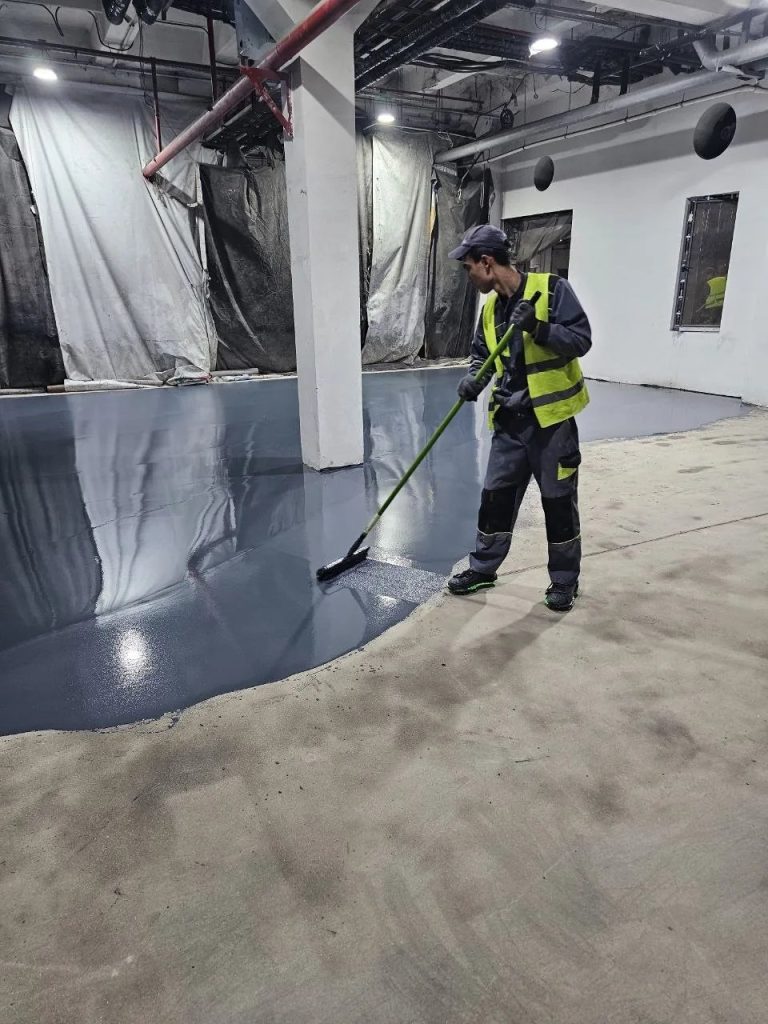
Polyurethane cement (PU-cement) flooring is built differently. It is a hybrid: a polyurethane binder plus cement and mineral filler. Because of the cement component, its thermal expansion is close to that of concrete. The layers move together, almost no shear stress arises at the interface, and the system withstands thermal shock.
This is not about “a better material”. It is a different physical principle for a different task.
What else a food plant does to a floor
Temperature is not the only load. Food production brings chemistry that you will find neither in a warehouse nor in a machine shop:
- lactic acid — cheese, fermented dairy products;
- fats and blood — meat processing;
- sugar solutions — confectionery and beverages;
- brines and salt — salting, fish;
- alkaline detergents and disinfectants, often hot.
Epoxy holds up fairly well against dilute acids and alkalis. But the organics of food production combined with heat are a tougher story, and here PU-cement again wins not “in general” but on a specific list of substances.
And separately: shock freezing and freezer rooms. The same thermal shock there, only in the opposite direction.
Where failures actually start
Almost never in the open floor area. Almost always at the junctions.
| Coves | The floor–wall transition must be part of the coating, rounded and made of the same material. A right angle at the wall is a place where water stands and the coating has an edge. The edge is the first to come away. |
|---|---|
| Floor drains and channels | The coating is taken into the body of the floor drain and terminates there, rather than stopping short next to it. If a joint is left between the coating and the drain, water gets under the floor with everything dissolved in it, and from then on delamination proceeds from within, unseen, until the coating bulges. |
| Anchor grooves | Around the perimeter, along the floor drains and at thresholds, the material is taken into a cut groove. This is a mechanical key that holds the edge when adhesion weakens under load. |
If the estimate has no separate lines for coves, drain detailing and anchor grooves, it was not drawn up for a food plant.
Thickness: from 4 to 9 mm, and that is not a safety margin
PU-cement thinner than 4 mm does not work. Here the thickness is part of the mechanism: it absorbs the temperature gradient and keeps it from reaching the interface with the concrete at full strength. A thin layer does not do that.
For steam cleaning and constant boiling water, the top of the range is used. For an area with occasional hot spills, the middle is enough. We covered how thickness relates to load in general in the article “Epoxy self-levelling floor: how to choose the thickness for the load”.
A bonus few people know about
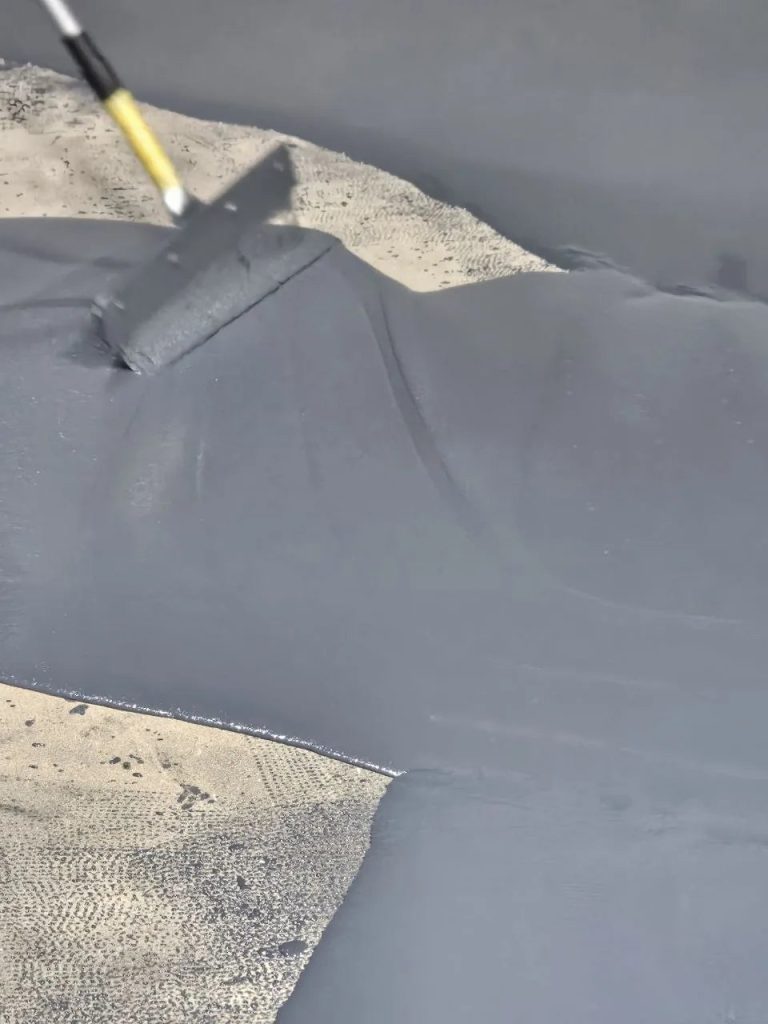
PU-cement systems are vapour permeable. This has two practical consequences:
- They can be laid on young concrete that has not yet reached the standard 28 days — this saves weeks on site.
- They can be laid on a substrate with residual moisture higher than epoxy allows: moisture from the slab does not accumulate under the coating and does not tear it off with vapour pressure.
For a project on a tight schedule, or for an old production hall with no waterproofing under the slab, this is often the deciding argument.
An honest word about appearance
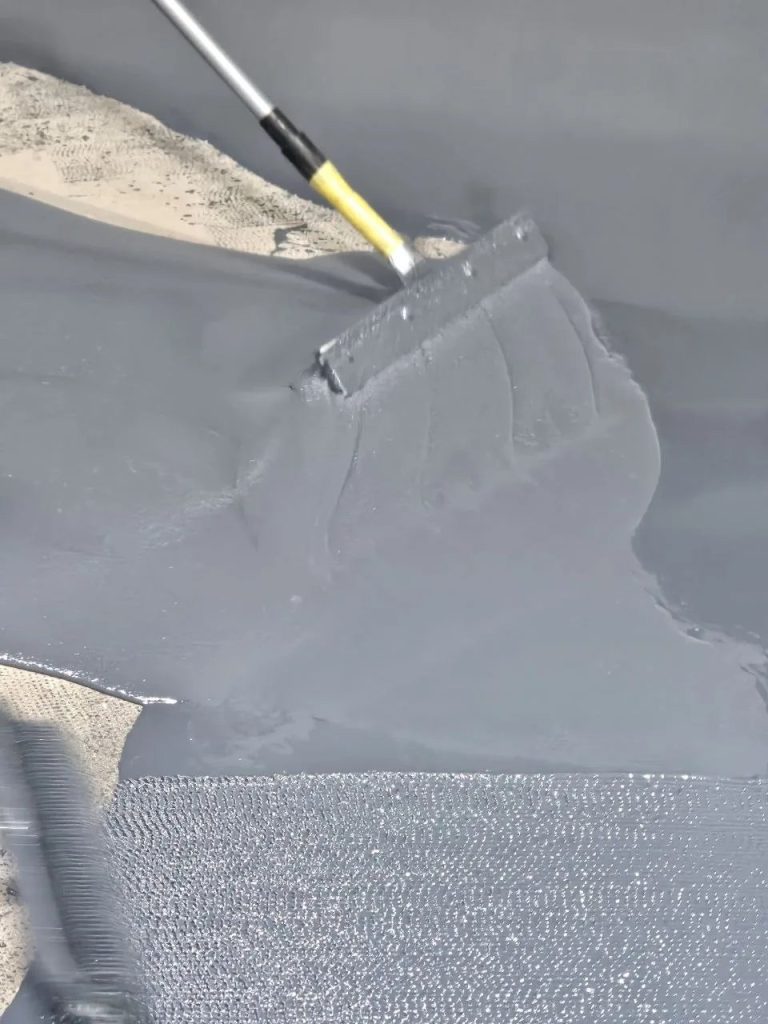
This is not a glossy floor. The surface is matt and textured — and that is not a compromise but a requirement: a wet production area needs a slip-resistant profile, not a mirror. A client who has seen photographs of mirror-gloss epoxy floors should be told this before work starts, not at handover.
The slip-resistance class is chosen zone by zone: where water and fat are constantly present, a coarser profile is needed than in the dry part of the plant.
When PU-cement is not needed
An honest limit, because the material is not cheap.
A dry finished-goods warehouse, the packing area, corridors, the office section — there is no thermal shock there, and PU-cement would be an overspend. Lay epoxy of the right thickness.
A mixed plant is divided into zones: the wet and hot part gets PU-cement, the dry part gets epoxy. This is normal practice, not a half-measure.
What to check at handover
- thickness from test cut-outs, separately in the wet zone;
- coves: made of the same material, rounded, with no edge at the wall;
- floor drains: the coating is taken into the drain body, with no joint around the perimeter;
- anchor grooves around the perimeter and along the floor drains;
- slip-resistant profile — by zone, not one for the whole plant;
- no blisters or missed spots in corners and behind equipment.
What next
If you run a food production facility, tell us three things: what you wash with, at what temperature, and whether there is shock freezing. That is enough to tell whether PU-cement is needed throughout, by zone, or not at all.