
Epoxy self-levelling floor: how to choose the thickness for the load
When a contractor arrives on site, the conversation almost always starts with the wrong question. People ask: “how much does a self-levelling floor cost per square metre?” The right question is different: what thickness is needed here. That is what drives both the price and whether the coating survives to the end of its warranty.
An epoxy floor is not one material but a system of several layers. The very same resin can be rolled on at half a millimetre, or laid as a five-millimetre self-levelling mortar with quartz filler. The difference in price is several-fold, and so is the difference in durability.
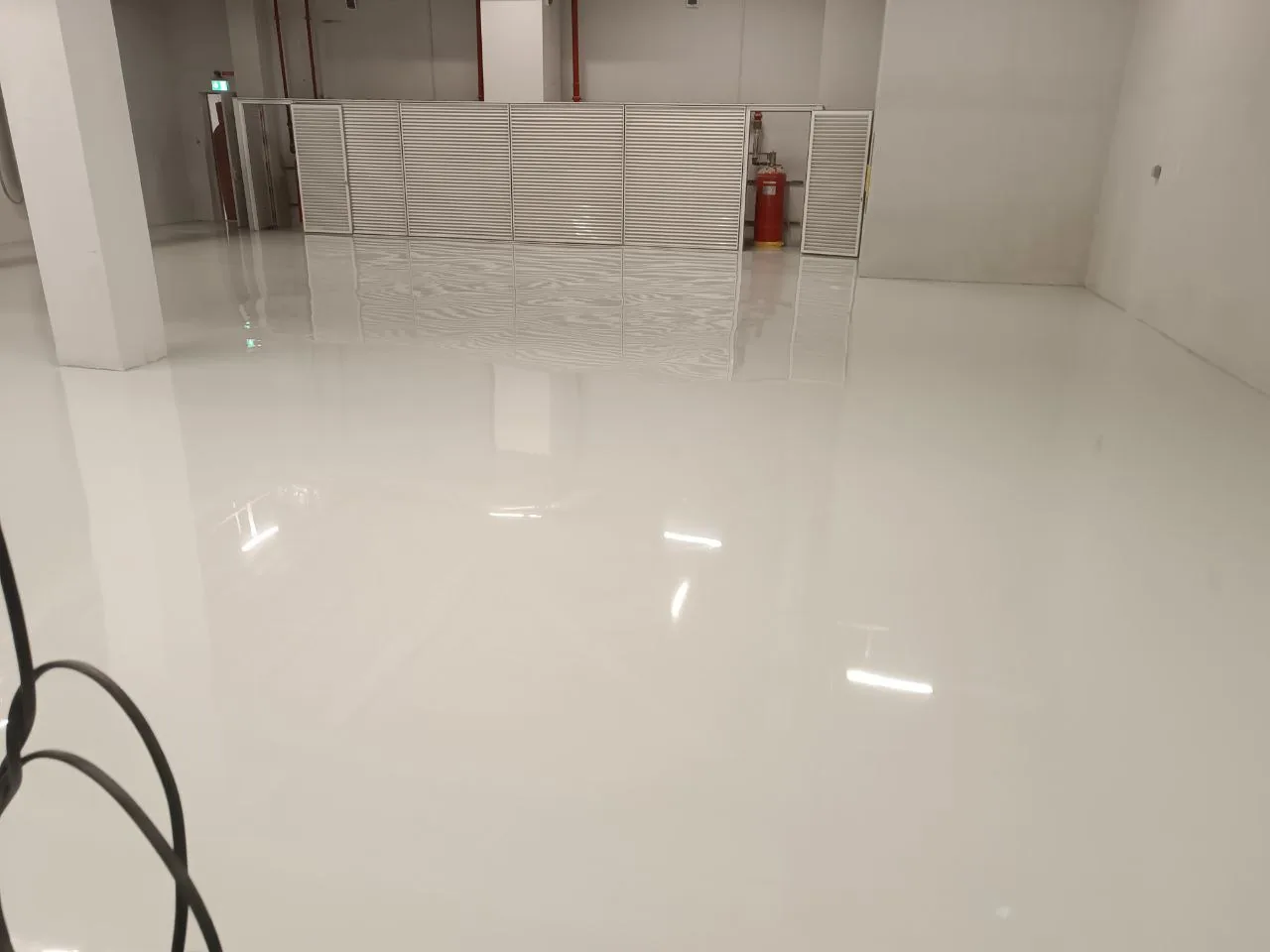
Thickness against load: the working table
Below is what we ourselves use when selecting a system.
| Up to 0.5 mm thin roller-applied coating |
Light foot traffic. Utility rooms, switchgear rooms, storerooms, corridors, warehouses holding packaged finished goods with no vehicles. The purpose of this floor is not wear resistance but dust-sealing the concrete and allowing wet cleaning. Consumption of Stafloor EP Finish at 0.5 mm is about 0.80 kg/m². |
|---|---|
| 0.5–1.5 mm self-smoothing coating |
Moderate load. Retail and exhibition halls, light warehouses, rooms with trolleys and occasional pallet-truck movement. At this point you get a flat seamless surface and noticeable abrasion resistance. Consumption is about 1.60 kg/m² at 1 mm. |
| 1.5–3 mm self-levelling coating |
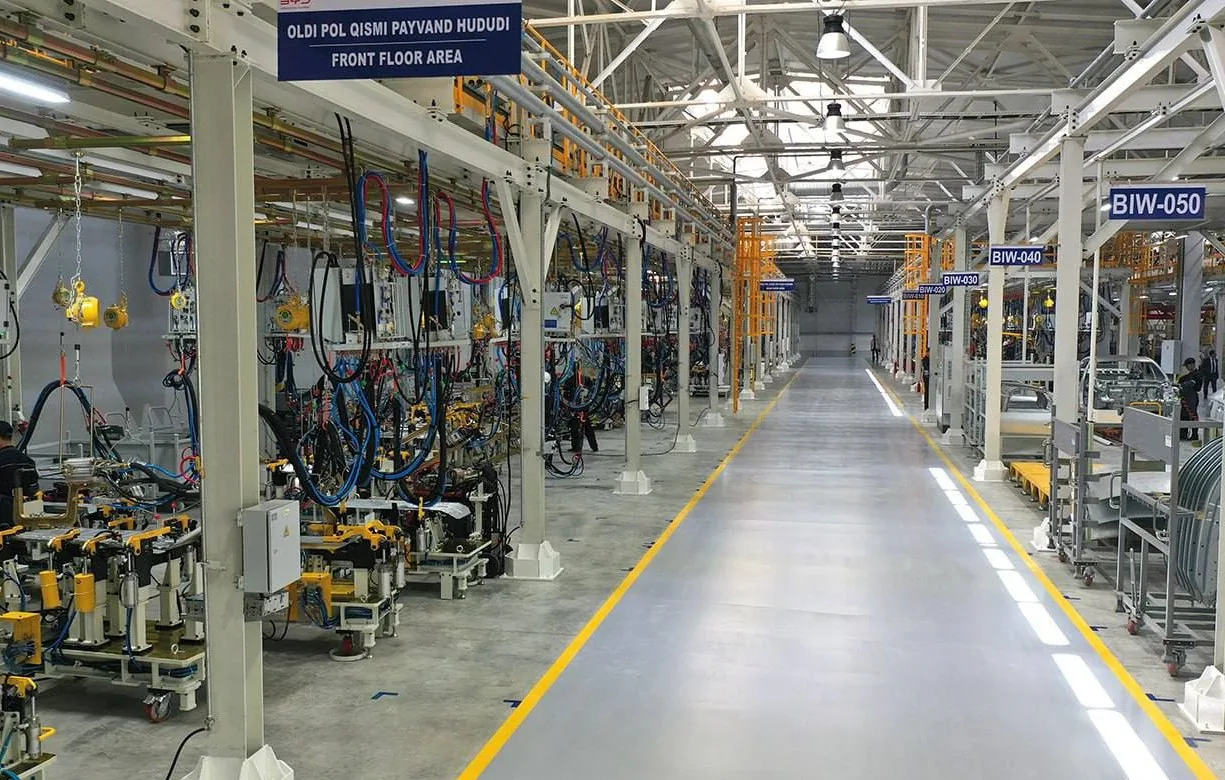
Production halls, warehouses with electric forklifts on polyurethane wheels, constant movement of people and equipment, regular washing. This is the most common choice for a working plant. |
| 3–5 mm self-levelling mortar with quartz filler |
Heavy load. Forklifts on solid wheels, impact loads, unloading bays, aisles under pallet racking, areas where tools and containers are dropped. Here the filler works the way aggregate works in concrete: it takes the impact. |
| Non-slip version over any of the systems |
Wet areas, ramps, places where oil and water are spilt. It is produced by broadcasting quartz sand into the fresh layer and sealing it afterwards. The slip class depends on the sand grading: R11/V4 with 0.1–0.7 mm sand, R12/V6 with 0.7–1.2 mm sand to DIN 51130. |
One caveat, without which the table does harm: it is a guide, not a standard. The final thickness comes from the design and from the real conditions on site — traffic intensity, wheel type, chemical load, cleaning regime. If someone quotes you a thickness without asking about your equipment and your washing routine, they are guessing.
What is behind these figures
Stafloor EP Finish is a solvent-free two-component epoxy material with a working range from 0.5 to 5 mm. A single product covers the whole range: there is no need to keep five different materials in stock for different thicknesses.
Measured properties of the cured coating:
- compressive strength 52 N/mm² (DIN EN ISO 604, 7 days at +23 °C);
- Shore D hardness 64 (DIN EN ISO 868);
- abrasion 50 mg per 1000 cycles, Taber abraser, CS 10 wheel, 1000 g load (ASTM D 4060);
- abrasive wear about 6 cm³ per 50 cm² (DIN 52108);
- heat resistance: continuously up to +80 °C, briefly up to +100 °C in dry conditions and up to +80 °C in wet conditions;
- chemical resistance to dilute acids and alkalis, salts, many solvents, fuel, fats, oils, cleaning and disinfecting agents and foodstuffs;
- the coating is impermeable to liquids and, once cured, physiologically safe — which is why it is used in food and pharmaceutical plants.
The primer coat is Stafloor EP Primer, a colourless solvent-free two-component binder. It penetrates the concrete, closes the pores and stops dusting; consumption is 0.25–0.40 kg/m² depending on the substrate. The same material serves as the matrix for epoxy screeds and repair mortars: the compressive strength of such a screed is 95 N/mm² to EN 196-1.
The substrate decides more than the material
Nine coating failures out of ten are not the material but the concrete underneath it. Before you price the job, check four things:
- Strength. The substrate must carry at least 25 N/mm² in compression and at least 1.5 N/mm² in pull-off adhesion. Pull-off is measured with an instrument, not by eye: a coating cannot be stronger than what it is bonded to.
- Moisture. No more than 4 % by the CM method. And separately — waterproofing from below: if moisture rises from under the slab, the epoxy will trap it and vapour pressure will tear the coating off.
- Surface. Flat, finely textured, free of laitance, oil stains and delaminating areas. Weak layers are removed by shot blasting or milling — not with a grinder “for appearance”.
- Conditions during application. From +10 to +30 °C for both air and substrate, relative humidity no higher than 80 %, and the surface temperature at least 3 °C above the dew point. The last one is forgotten most often: condensation on the concrete guarantees delamination even if everything else is done perfectly.
And one point where crews in a hurry come unstuck: the overcoating window. The next layer of Stafloor EP Finish goes on after 24 hours but no later than 72 hours. Miss the three days and the surface has to be sanded, otherwise the layers will not bond. Plan the schedule around this, not the other way round.
Pot life of the mixed material at +20 °C: 25 minutes for the primer, 20 minutes for the finish coat. Mixing more than the crew can lay is pointless — the remainder sets in the bucket.
Where epoxy is the wrong answer
An honest conversation about the limits saves both money and reputation.
Epoxy resin yellows under ultraviolet light — that is a property of all epoxies, not a defect. For outdoor areas and wherever colour stability matters, a polyurethane topcoat goes over it.
In food plants with steam cleaning, boiling water and shock freezing, epoxy performs poorly: there you need polyurethane-cement systems designed for thermal shock. For areas where the floor must be back in service within a day, or for freezer rooms, there are methyl methacrylate formulations. And where handover requires a measured electrical resistance report, you need an antistatic system, measured to IEC/EN 61340-4-1 — which is not the same thing as an ordinary earthing resistance measurement by an electrical laboratory.
Everything listed here is a separate class of material. If your site falls into one of them, say so at the start: we will not specify epoxy where it does not last.
What next
If you have the area, the type of equipment and the cleaning regime, that is enough for us to name a thickness and a system. If you also have a substrate strength report, we can also name the scope of preparation work — usually the most underestimated line in the budget.
Materials: Stafloor EP Primer and Stafloor EP Finish. Installation of industrial polymer floors is a separate service: we work both on material supply and turnkey.