
Antistatic floor: how it is accepted and why an electrical laboratory report is the wrong document
A scene that repeats itself on every other site. The floor is down, the contractor brings a report: resistance measured, laboratory stamp, everything within limits. The client’s quality department looks at it and says: this is not the right document. An argument starts in which both sides are honestly convinced they are right.
Both are right — they are simply talking about different things. Let us sort out which.
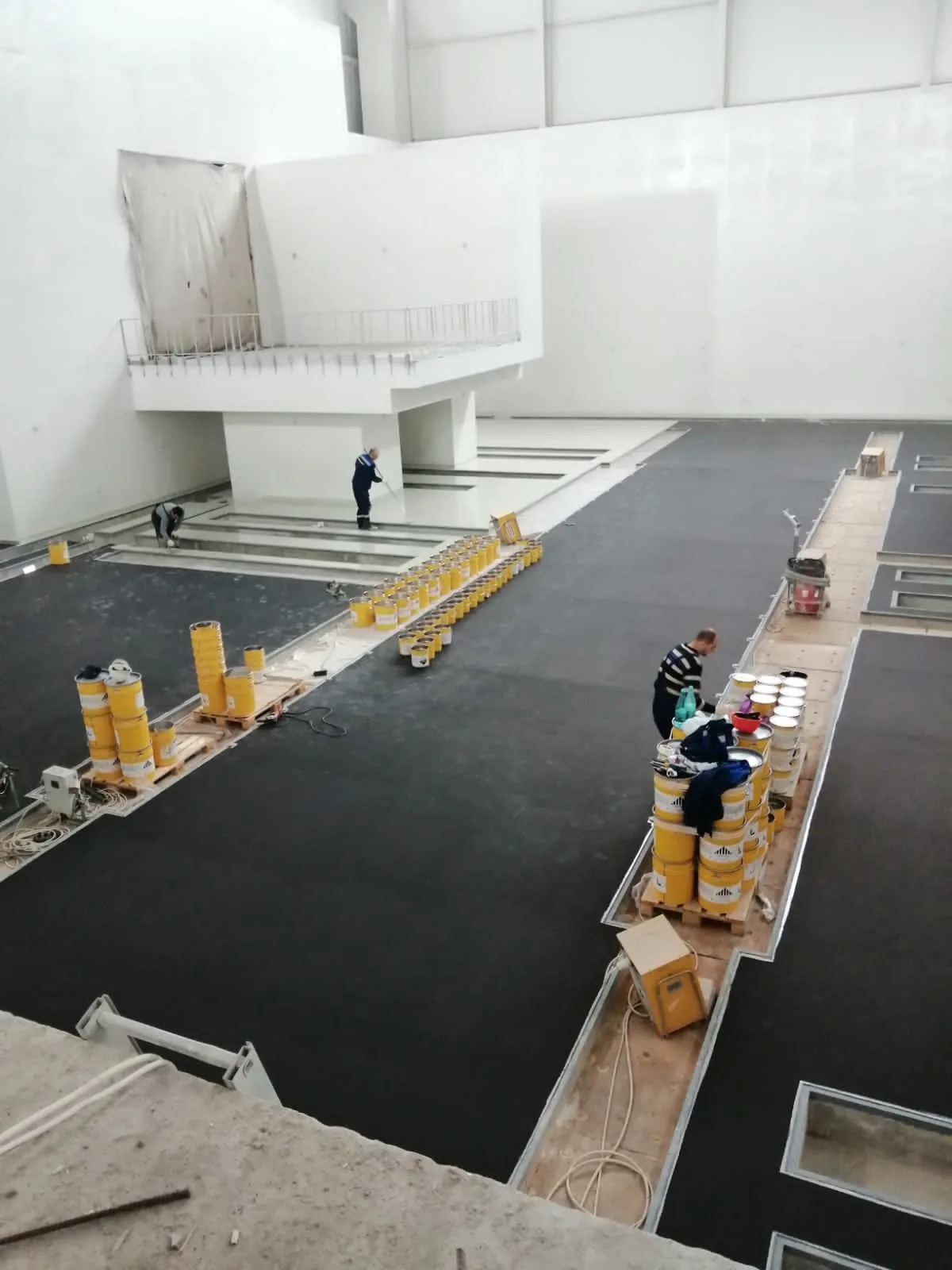
Two different measurements that get confused
| Electrical laboratory report to the wiring regulations | What is measured is the resistance of the earthing system and the phase-to-neutral loop, plus continuity of protective conductors and of the equipotential bonding. The instrument is an earth resistance tester. It answers one question: is the building earthed and is the electrical installation safe. |
|---|---|
| Measurement to IEC/EN 61340-4-1 | What is measured is the resistance of the floor covering itself: between two points on the floor, and from a point on the floor to the earthing point. The instrument is a megohmmeter with standardised 2.5 kg electrodes and a defined test voltage; air temperature and humidity are recorded in the report, because humidity affects the result strongly. It answers a different question: does the floor drain the charge, and at what resistance. |
Different objects, different instruments, different documents. A wiring-regulations report does not close an electrostatic requirement, and a 61340-4-1 report does not replace the electrical installation check. Both are needed, and that is not nit-picking.
What resistance is required
The value is set by the project or by the equipment manufacturer — not by the contractor and not by the material supplier. Two grades are usually distinguished:
- conductive — in the order of 10⁴–10⁶ Ω;
- dissipative (antistatic) — in the order of 10⁶–10⁹ Ω.
General requirements for an electrostatic protected area are set out in IEC 61340-5-1; in North American practice the same role is played by ANSI/ESD S20.20.
And straight away about a common misconception: «the lower the resistance, the better» is wrong. A floor that is too conductive is dangerous for people: touching damaged insulation, a person becomes reliably earthed themselves. That is why a range is specified, not «as low as possible».
The measurement everyone forgets
Floor resistance is not the only characteristic. The floor works as a system together with the footwear of the person walking on it, and the standards include a second measurement: the voltage that builds up on the body while walking (ANSI/ESD STM97.2, the «floor plus footwear» system).
What this means in practice: the floor can meet the resistance limits and still fail to deliver the required result if the staff walk in ordinary shoes. If the project talks about an EPA, footwear is part of the system, not a detail of everyday life. This is worth agreeing with the client before handover, not after.
What the system consists of
Briefly; in more detail — on the page about antistatic floors.
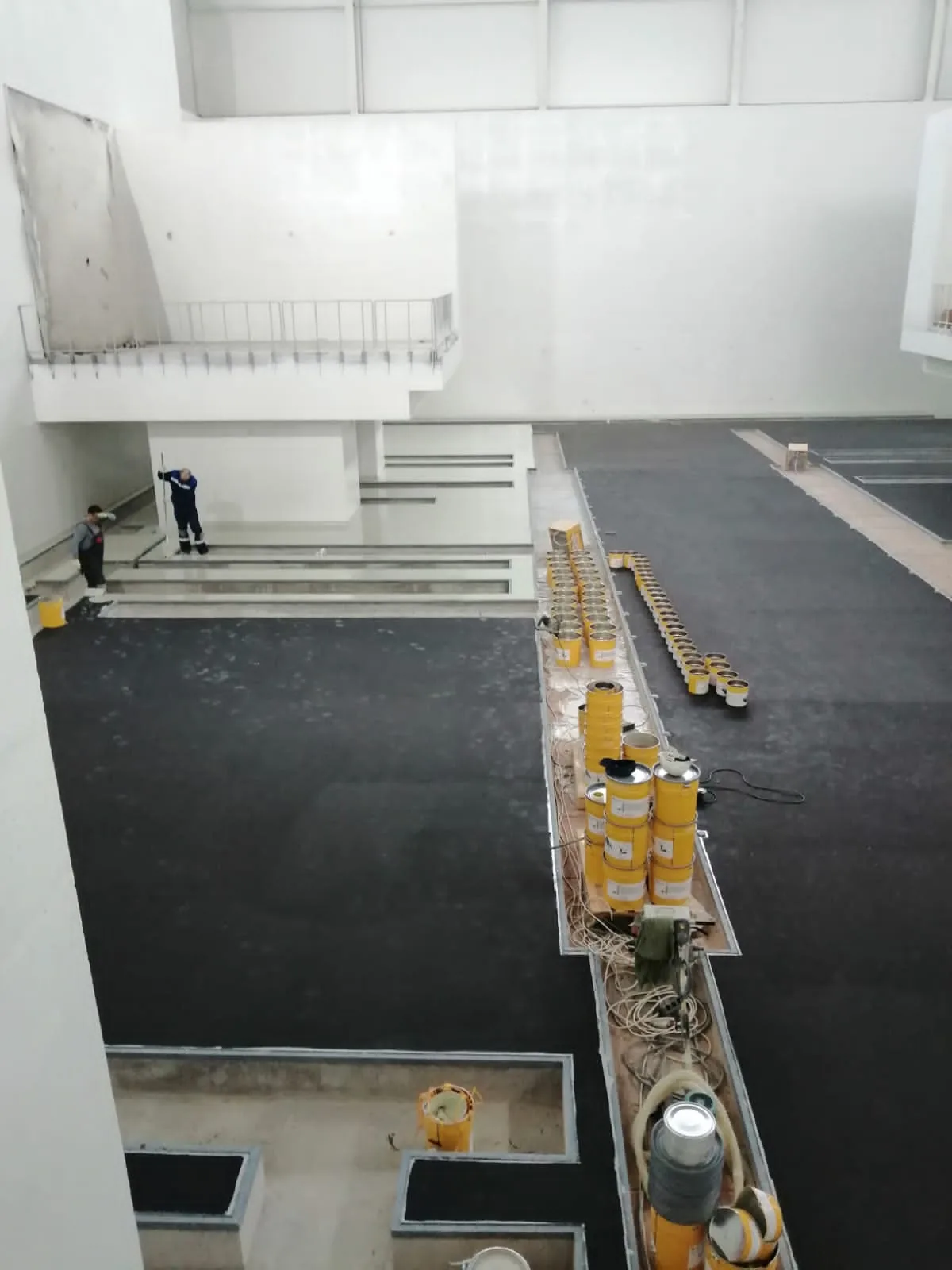
- Substrate preparation — as for any polymer floor: strength, pull-off, moisture content, dew point.
- Conductive primer.
- A grid of copper tape across the area, connected to the building’s earthing system. More than one connection point is made: at least two per room, then according to the area and the design. A single point is a single point of failure.
- Conductive carbon-filled intermediate layer.
- Top layer of the specified conductivity grade.
- Measurement and report.
Conductivity is provided by the filler inside the material, not by something applied on top. From this follows the point that costs more than all the others.
What kills an antistatic floor after handover
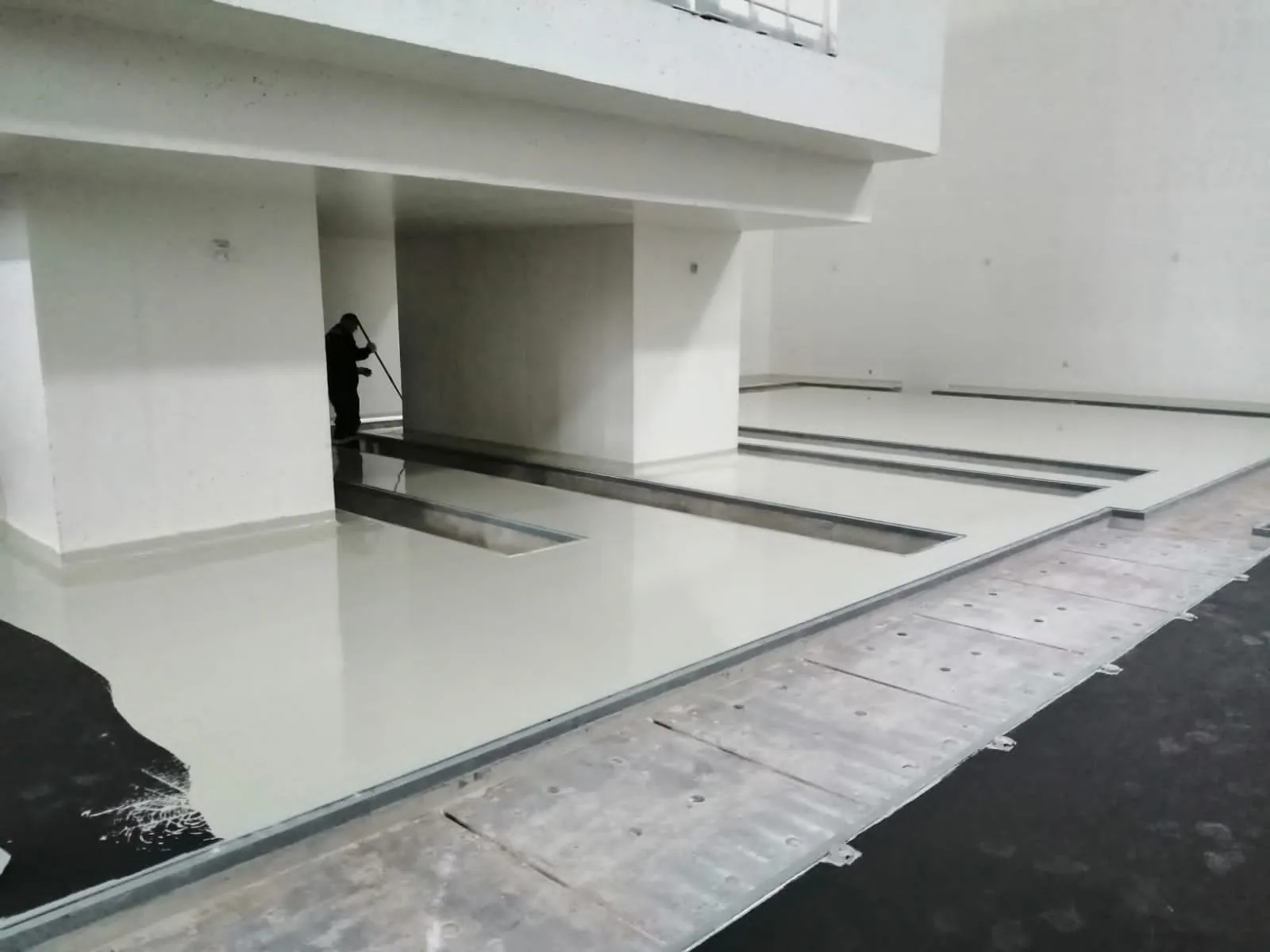
Polish and wax. Any product that leaves a film insulates the surface — and a floor handed over with a good report fails the repeat measurement a year later. Formally the coating is intact; in practice the function is gone.
That is why a cleaning regime is handed over together with the site: what may be used, what may not, how often to run a control measurement. We provide this in writing — not out of bureaucracy, but because this is exactly where certification is lost.
The second factor is air humidity. The resistance of the covering depends on it, and a measurement taken in a dry January may differ from a summer one. That is why the conditions of the measurement are written into the report.
What the handover certificate must contain
So that a year from now there is something to refer to:
- the document the floor was accepted against — IEC/EN 61340-4-1 (and the project requirements with a reference to IEC 61340-5-1 if it is an EPA);
- a layout of measurement points tied to the plan;
- point-to-point and point-to-earth values for every point;
- air temperature and relative humidity at the time of measurement;
- the instrument, its serial number and calibration date;
- a layout of the earthing connection points;
- the cleaning regime handed to the client — with a signature confirming receipt.
Seven items, of which the fourth and the seventh are missing most often — and those are exactly the ones people argue about later.
What an antistatic floor does not do
An honest boundary, so that nothing extra is expected of it.
It does not replace the earthing of equipment and does not remove the requirements for the electrical installation. It does not replace personal protective equipment in an EPA — wrist straps, footwear, coats. On its own it is not a fire safety measure, although in explosive atmospheres it is part of a set of measures.
And it does not work «in general»: it works to a specified resistance, under specified conditions, with specified maintenance. All three parts are mandatory.
What to do next
If your project says «antistatic floor» — ask the designer or the equipment supplier for two numbers: the required resistance range and the document the floor will be accepted against. With those two numbers, selecting the system takes one conversation. Without them any calculation is guesswork.
One more thing, to avoid misunderstanding: we do not have our own line of antistatic materials. We work with systems from different manufacturers and select the composition to suit the project requirements, rather than fitting the site to whatever is in the warehouse.
If there is no electrostatic requirement, the task is simpler and cheaper — see epoxy floors.